Strawberry Generation: Fragile…or Failed by the System We Built?
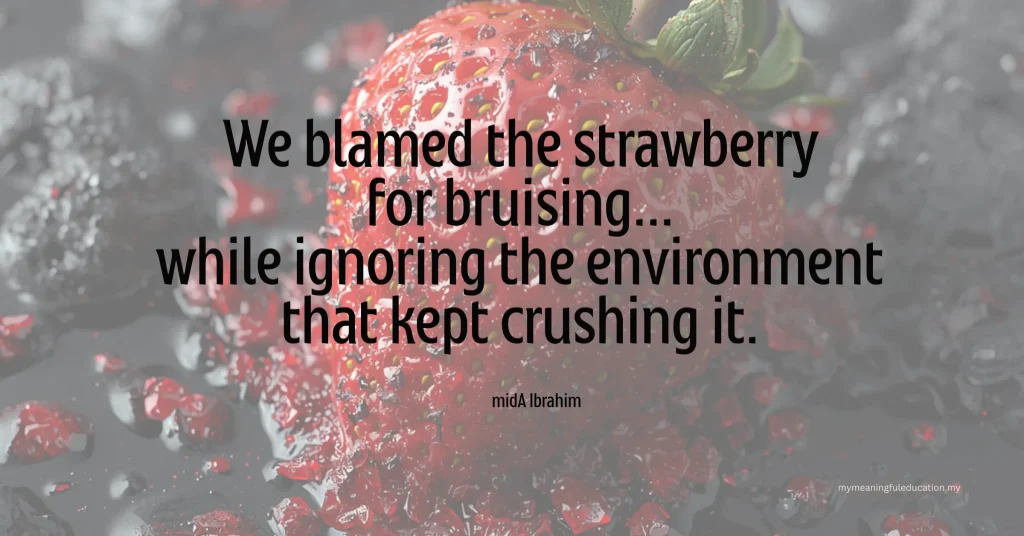
The Weight of a Label
The way we mother today quietly shapes the resilience of tomorrow. Awareness is what ensures we do not unconsciously recreate the conditions that form the next “Strawberry Generation.”
The label: Strawberry Generation. This is a term that emerged from Taiwanese social commentary to describe a generation perceived as polished, yet easily bruised under pressure.
Beneath that label, we can observe a quieter pattern. Society raised this generation to achieve, stay connected, and appear outwardly capable. However, when pressure lingers instead of passing, many begin to struggle. The problem does not stem from a lack of intelligence, but from systems that emphasized performance more than endurance. As a result, people often dismiss this response as fragility, when in reality, many never had the opportunity to fully train resilience to carry sustained weight.
However, this same generation now stands at the helm of society. We cannot stop at the bruise. The harder question is this: why did its resilience begin to soften in the first place?
And more importantly, where do we go from here?
Because identifying or labeling a generation is never the end of understanding. The beginning of responsibility begins there. Something must now be done by the older generation: not to blame, but to rebuild the conditions that shape resilience, guidance, and growth.
But responsibility does not end with the older generation. Those within this generation must also choose not to remain defined by the label, but to actively rebuild their own capacity for resilience. Awareness, discipline, and the willingness to grow through pressure rather than avoid it.
Before judgment, let us first understand the system that formed them.
Who Educated the Strawberry Generation and Why It Formed?
We do not shape the Strawberry Generation through a single group or individual, but through a system…an ecosystem formed by parents, educators, and institutions acting under shared pressures of survival, achievement, and social comparison.
Parents, driven by fear of instability, often overprotect. Educators, constrained by performance metrics, prioritize measurable success over developmental depth. Meanwhile, institutions reinforce a system that rewards outcomes more than process.
Over time, this creates an education culture that becomes highly structured, highly competitive, and emotionally protective. However, overprotection does not always support healthy development. When we define success primarily through performance and the pursuit of top tier achievement, without sufficient exposure to failure, discomfort, and gradual challenge, we constrain adaptation rather than expand it.
Research from the Harvard Center on the Developing Child also highlights how prolonged toxic stress and unhealthy developmental environments can affect resilience, emotional regulation, and long term adaptation. At the same time, environments that become excessively protective and remove all meaningful exposure to challenge may also limit the development of resilience, frustration tolerance, and adaptive coping over time.
I write this not as a judgment, but as a mother and former educator who invites reflection on how environment shapes adaptation. In my experience in developmental neurotoxicology, where I study environmental toxicants and their effects on the developing brain, I often observe the same principle in a different form: context matters deeply in shaping outcomes.
In neuroscience, the concept of “windows of susceptibility” in brain development shows that sensitive periods exist when the brain responds to environmental input. During these periods, experience does not merely influence behaviour, it helps shape the architecture of the developing brain.
The Information-Transformation Gap
We are living in an era characterized by mountains of information, yet we face a desert of transformation.
The Strawberry Generation stands among the most informed generations in history. We access global knowledge within seconds. We understand climate data, follow economic shifts, and track technological innovation in real time.
However, information alone does not produce transformation.
This gap creates a unique form of “bruising” within the strawberry generation. It reflects the burden of awareness without the corresponding tools, guidance, or structured support to act upon that awareness.
Consequently, many young adults enter a state of action paralysis. The brain becomes overwhelmed by complexity, and instead of responding, it withdraws to protect itself.
The Possible Neurobiology Behind the Strawberry Generation
TThe Possible Neurobiology Behind the Strawberry Generation
Modern neuroscience continues to show that the brain adapts to its environment. Chronic stress, emotional pressure, overprotection, and prolonged survival states can influence how individuals respond to challenge, discomfort, and uncertainty over time.
This does not reduce human beings to biology alone. However, it reminds us that resilience is not shaped in isolation. Environment, experience, and repeated patterns of adaptation all play a role in how people learn to respond to pressure.
The deeper neurobiology behind this process deserves further discussion, and I hope to explore it more thoroughly in future writings.
Rebuilding Resilience with Rahmah and Responsibility
As the older generation, this calls for a response grounded in rahmah, not judgment. Those entrusted with greater experience, authority, and knowledge carry the responsibility to guide with patience, wisdom, and mercy, while actively rebuilding environments that support healthy human development.
This responsibility reflects a deeper Qur’anic principle found in Surah Al-An’am 6:165, where human beings are entrusted with responsibility, stewardship, and differing levels of authority as part of a test in how they guide and manage what has been placed under their care. If you belong to the older generation and guide individuals within the Strawberry Generation, then you now hold the opportunity to invest beneficial knowledge, wisdom, and character development into others in ways that can continue benefiting society long after you leave your current position, authority, or career.
At the same time, for the Strawberry Generation itself, awareness becomes the starting point. Once you understand how your responses have been shaped, responsibility begins to shift inward.
This is where growth becomes intentional: you learn to engage discomfort, strengthen emotional regulation, and actively rebuild resilience through disciplined exposure to challenge, rather than avoidance of it.
Just as muscles require controlled tension to strengthen, character requires the right kind of pressure to mature. Constructive stress stimulates adaptation, while chronic stress can trigger a survival shutdown within the system.
In this state, the Reactionary Brain tends to remain in a loop of anxiety, constantly anticipating the next “bruise.” In contrast, the Stewardship Brain learns to recognize stress not as a threat, but as a signal for growth and development.
A Call For The Older Generation: From Labeling to Guiding
At this point, the responsibility extends beyond the Strawberry Generation itself.
Parents, educators, and the older generation must recognize their role in shaping both the information and the emotional scaffolding required for transformation.
Labeling alone does not heal. Criticism alone does not guide. Complaint alone does not rebuild.
When we reduce a generation to a label, we stop seeing their potential and start reinforcing their limitation.
Instead, the responsibility now shifts toward re-education with rahmah. Hence, guidance must be delivered with clarity, patience, and mercy.
The older generation must move from observation to contribution. They must not only point out the gap but actively help bridge it.
This means teaching not just what to think, but how to process pressure, how to fail safely, and how to translate knowledge into action.
Because transformation does not happen through information overload. It happens through guided experience, patient correction, and consistent support.
And we must remember this clearly:
The Strawberry Generation will one day become the adult generation that will shape the worldview, decisions, and lived reality of the inheritors of today’s older generation.
A Call for the Strawberry Generation: From Reaction to Resilience
If you feel a spark of irritation when elders refer to you as part of the Strawberry Generation, that response matters. It signals awareness, an internal resistance that refuses limitation. It reflects a recognition of potential that has not yet been fully expressed.
Use that pressure wisely. As you unlearn inherited fragility, you must also relearn a deeper truth: not all friction is destructive. When a challenge aligns with higher purpose and serves what is right, that stress becomes training. It becomes the heat that shapes resilience, like clay hardened by fire. In this sense, resilience is not the absence of pressure, but the ability to remain shaped and strengthened under it.
However, discernment is essential in this journey. Not every form of pressure builds growth, and not every environment deserves endurance. Within discussions about the Strawberry Generation, we must distinguish between two realities: constructive stress and chronic toxic stress.
Constructive stress strengthens growth. It aligns with purpose, develops skill, and expands one’s capacity to contribute meaningfully to society. Chronic toxic stress, however, arises from emotional abuse or systemic manipulation. It does not build resilience; it erodes it. It diminishes human dignity and leads to prolonged psychological exhaustion rather than development.
Your mental health matters, not as an excuse to avoid growth, but as a trust that must be protected from environments that continuously destroy human dignity.
True leadership is rooted in truth. A parent, educator, or leader may challenge the Strawberry Generation, but that challenge must never come at the cost of dignity. Resilience is built through struggle, but it collapses under cruelty.
Discernment, Dignity, and Responsible Speech
Even so, the label must never become a cage. Even if others define you as the Strawberry Generation, you remain a human being with capacity, direction, and the ability to move forward.
And if any environment becomes so toxic that it limits your ability to breathe, grow, or remain whole, then walking away is not weakness, it is wisdom. Use your legs to find ground where growth is still possible, and use your hands to build rather than merely consume.
And use your voice with responsibility. Not simply to echo noise, but to speak words that build, heal, and guide. Because in every generation, what is spoken either strengthens a society or weakens it. Words shape direction, or they deepen confusion.
So let your speech become part of your contribution, not your distraction. Speak with awareness, not reaction. Speak with purpose, not pressure. Speak not for noise, but for meaning, grounded in humility and adab.
I do acknowledge that many toxic cultures exist within our society. However, overcoming toxicity is not achieved by becoming more toxic in return. Wisdom is the ability to respond with discernment, restraint, and principled strength. It means refusing to lose your dignity, adab, or sense of direction in the process.
True change is not built through reaction alone, but through the discipline to remain grounded in truth while refusing to replicate the very harm one is trying to overcome.
From Touch-and-Go to Lifelong Responsibility
The responsibility has shifted, and it now rests squarely on your shoulders. You are no longer merely a product of the orchard; you must now become the gardener.
You may have been shaped by a “touch and go” approach to life, moving through systems, tasks, and achievements without deep continuity. But now, this must evolve into something more intentional and enduring.
Stop asking, “How can I be happy?”
Instead, ask, “What problem was I created to engage with?”
Shaping society is not a quick fix. It is not a viral TikTok moment or a one-time contribution. Rather, it is a slow, deliberate craft. It requires consistency, discipline, and presence, especially when motivation fades.
Happiness is not a destination. A fulfilled life is one that moves toward self-actualization and service to others, where growth is not only personal, but also returned to the world with meaning.
As the Prophet Muhammad ﷺ said: “The best of people are those who are most beneficial to others.”
Move with agility when pressure demands adaptation. Use digital fluency and creative thinking to build systems that improve what came before. At the same time, remain anchored in purpose, not impulse.
You have legs for a reason. You have a mind capable of creation for a reason. Do not allow a label to define your capacity for impact. If you find yourself in a toxic system, walk away. But once you find solid ground, stand firm.
Pick up a problem. Build a better system. Realign your life with the purpose the Creator intended for you. Move from bruised strawberry to purposeful steward.
This is is not a story of perfection. A touch and go mindset may have been sufficient for survival in a fast-moving world, but it is not enough for building legacy, meaning, or sustainable contribution.
Strawberry Generation: Fragile, or Still Becoming
We are human beings…never flawless, never static. We may drift, we may bruise, we may lose direction along the way. But the path back is never closed.
Thus, we must never turn the label into a verdict. We should see it as a reflection, not a final identity. The system may shape us, but it does not seal us. And the return toward growth, responsibility, and meaning remains always open.
Strawberry Generation: Fragile… or failed by the system we built?
Perhaps the deeper truth is this: neither.
We are simply a generation still learning how to stand, and still capable of rising.